

One of the things I love about travel is finding
interesting sites that make you curious to learn more about something.
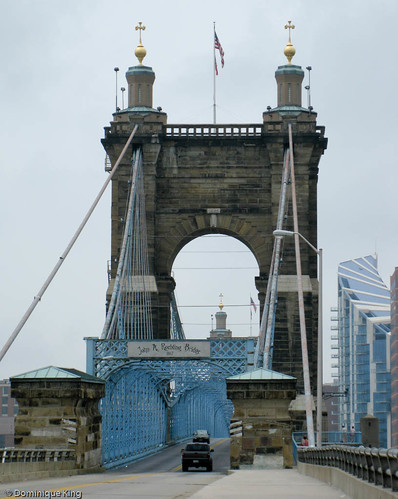
The John A. Roebling Bridge spanning the Ohio River to
connect Cincinnati (Ohio) and Covington (Kentucky) fascinated me from the first
time I laid eyes upon it. The stately brick arches, bright blue paint and the
sign identifying it as the "John A. Roebling Bridge - 1867" looked a
bit incongruous next to the modern riverfront buildings in both cities. The
contrast was especially sharp approaching Covington and the ultra-modern Daniel
Libeskind luxury residential complex, although The Ascent complex echoed some of
the curves and bright blue color of the old bridge.
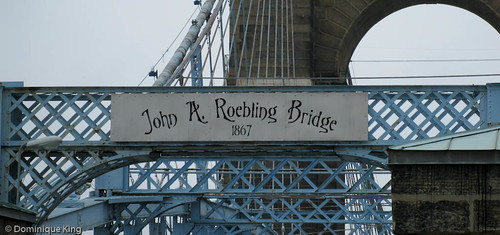
The John A. Roebling Bridge had pedestrian walkways, so it
became a must that I walk across the bridge and snap a batch of photos from
nearly every imaginable angle!
There are a number of bridges spanning the river at
this point, but the John A. Roebling Bridge holds several distinctions. The
bridge, completed in December of 1866, was the first to span the river and,
over 140 years after its opening, still serves as a crossing for pedestrians
and vehicular traffic.
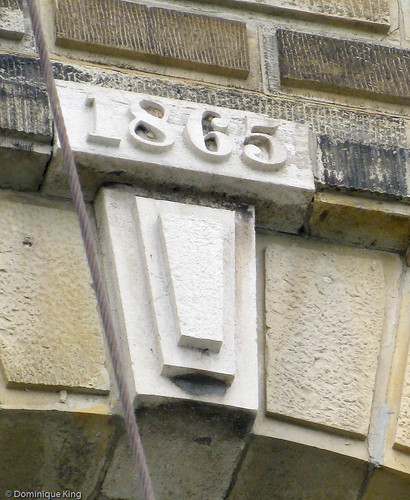
The bridge served as a prototype for the Brooklyn
Bridge, also designed by Roebling and seen to completion by his son, Washington
A. Roebling. Washington Roebling also supervised work at the bridge
over the Ohio River while his father planned the Brooklyn Bridge project.
The decade-plus construction period for the John A.
Roebling Bridge also echoes the 14-year effort that it took to complete the
Brooklyn Bridge by 1883.
I thought again of my walk across the Roebling
Bridge as I finished the massive David McCullough book, The Great Bridge: The Epic Story of the Building of the Brooklyn Bridge.
It was, after all, the Roebling Bridge that led me to tackle reading
McCullough's 562-page book about the building of the famed New York bridge.
McCullough's book is a detailed account of the Brooklyn
Bridge construction and both Roeblings' part in its design, execution and the
fascinatingly gruesome manner in which both bridges claimed the health of
father and son. John A. Roebling died after a workplace accident at the
Brooklyn Bridge and subsequently contracting lockjaw. Washington A. Roebling
experienced years of impaired health after contracting the bends as a result of
his work at the Brooklyn Bridge. The book was technical in parts, but offered
some interesting insights into bridge construction, technology and politics of
the time.
But first, there was the John A. Roebling Bridge
between Cincinnati and Covington.
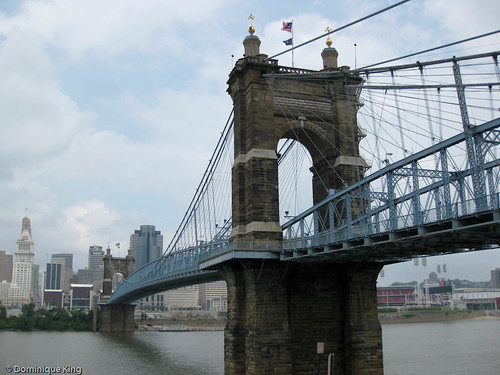
Increasing ferry traffic on the Ohio River between
Ohio and Kentucky drove the desire for a bridge between the two states. Ferryboat
operators and steamboat companies were understandably less than enthused about
the bridge proposal. Cincinnati's role as a major Underground Railroad conduit
for slaves seeking a safe route north to freedom also led others to oppose the
bridge because they felt would ease the journey for escaping slaves.
Bridge construction eventually began in September of
1856. Inflation and war caused construction delays throughout the Civil War.
The central 1,057-feet span was the longest in the
world when the bridge opened to traffic on January 1, 1867. Its larger cousin,
the Brooklyn Bridge, became the longest bridge upon its 1883 completion.
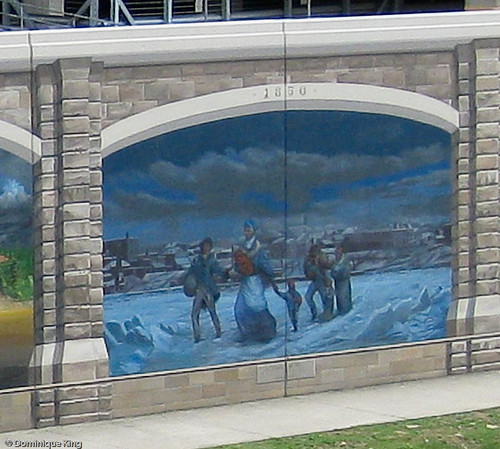
Be sure to visit look for the Roebling statue and
historical marker on the Kentucky side of the river when you visit the John A.
Roebling Bridge, as well as the Roebling Murals. The 18 murals, on the
floodwalls near the bridge, represent the largest public art display in the
area and depict scenes from Covington, Northern Kentucky and the bridge's
history--like this mural "The Flight of the Garner Family". The
Garner mural shows the family's 1856 run across the frozen river toward freedom,
an event that the murals committee says helped inspire author Toni Morrison as
she wrote Beloved.
© Dominique King All rights reserved









I love bridges. Great pictures--thans for sharing!
Posted by: angela | September 24, 2009 at 05:51 AM
Angela-Thanks for stopping by! I've got a thing for bridges myself, and this was such an interesting old bridge (still in service)!
Posted by: Dominique | September 24, 2009 at 03:10 PM
Very cool when a structure can illustrate history with the story of how it was built, why it was built, and the personal lives of those who built it. I find that so fascinating. Great post!
Posted by: Lora | September 27, 2009 at 08:16 PM
Lora-Thanks! I just knew the bridge would have a cool backstory when I first saw it.
Posted by: Dominique | October 01, 2009 at 02:34 PM